


Perimenopause Symptoms: What Hormone Changes Can Really Feel Like
Authors:

Ashley Palmer
Nutritional Therapy Practitioner, Health & Wellness Expert
Key Takeaways:
You wake at 3 a.m. again. No nightmare, no noise. Just a racing heart and a mind that won't settle.
Your knees complain on the stairs in a way they didn't last year. You lost a word mid-sentence in a meeting. You've been shorter with the people you love than you'd like to admit.
Your periods still show up. You've never had a hot flash. So you've crossed off the one explanation everyone talks about. You think surely you must have a few years to go before shifting hormones really become an issue.
Here's the truth: perimenopause often looks nothing like the version most of us were told. Hot flashes aren't always the opening act, and the earliest changes are often the hardest to connect to hormone shifts. The picture gets much clearer when you look at it the way your cells experience it: as a signaling story.
In this blog, we'll cover what perimenopause actually is, why its symptoms feel so unpredictable, how long they can last, how to tell if your symptoms are connected to perimenopause, and where healthy fats and cellular nutrition fit in.
Table of Contents:
-
What Is Perimenopause, Really?
-
Why Do Perimenopause Symptoms Feel So Random?
-
How Do You Know If It's Perimenopause?
-
How Long Can Perimenopause Symptoms Last?
-
What Can Truly Help?
-
Why Do Healthy Fats Matter for Perimenopause?
-
Where Does Evening Primrose Oil Fit?
-
Supporting Your Cells Through Perimenopause With Evening Primrose Oil
What Is Perimenopause, Really?
Menopause is technically a single point in time: the day you reach twelve months without a period. You can only recognize it looking back.
Perimenopause is the transition leading up to that day, and it's where most of the action happens.
Researchers break reproductive aging into distinct phases, marked first by shifts in cycle length and later by skipped periods. This is a gradual process with recognizable stages, not a switch that flips overnight.
Here's the part most explanations skip: perimenopause isn't just estrogen slowly declining. As ovulation becomes less regular, estradiol and progesterone can swing up and down from one cycle to the next. Menopause brings consistently low hormone levels. Perimenopause brings unpredictable ones.
Think of it less like a dimmer switch being slowly turned down and more like a radio signal periodically cutting in and out. That visual explains a lot of what comes next.
Why Do Perimenopause Symptoms Feel So Random?
The familiar signs of perimenopause are the ones you'd expect: irregular periods, hot flashes, night sweats, vaginal dryness.
But plenty of women notice something else first. Sleep that won't stay put. Trouble concentrating. Words that hide on the tip of your tongue. Mood swings, new anxiety, or a shorter fuse. Joint and muscle aches. Headaches that behave differently than they used to.
A 2025 review of cognitive, sleep, and mood changes during the menopause transition describes brain fog, mood changes, and sleep disruption as common, and notes they can affect quality of life, productivity, and relationships.
These symptoms feel wild partly because nobody told you to expect them. None of them announce themselves as “hormonal,” and each one has other plausible explanations.
That’s important to define. Not every new symptom in midlife is perimenopause. Thyroid conditions, low iron, sleep apnea, and depression can all look similar. The goal is to keep hormones on the list without making them the only thing on it.
How Do You Know If It's Perimenopause?
Hormone testing is less helpful here than most people expect because of constant fluctuations. A single blood draw captures one moment in a pattern that shifts week to week.
A systematic review on diagnosing perimenopause concluded that no single symptom or test is accurate enough on its own, and recommended that clinicians rely more on age and menstrual history rather than lab results.
That makes your own observations valuable. Tracking your cycle, sleep, mood, and energy for a few months gives your practitioner a clearer picture than any one lab value.
Hormonal changes can begin earlier than many women expect, though recognizable perimenopause most often shows up in the early-mid 40s. If cycle changes or new symptoms start well before that, get a proper evaluation, since other causes can look similar.
Many women say their symptoms were overlooked or chalked up to stress. If that sounds familiar, your experience is valid and unfortunately common. New or disruptive symptoms deserve a thorough conversation with a practitioner who takes them seriously, and the notes you've been tracking can help guide both of you.
How Long Can Perimenopause Symptoms Last?
A large, long-term study of midlife women across the U.S. found that frequent hot flashes and night sweats lasted a median of 7.4 years. For many women, these symptoms continued for about 4.5 years after their final period.
That's longer than the two-to-four-year version most women are told to expect. For women whose frequent symptoms started early in the transition, the median stretched past eleven years.
One clarification: those numbers describe how long hot flashes and night sweats lasted, not a fixed length for perimenopause itself. The point is, every timeline is different.
What Can Truly Help?
Some women move through perimenopause with little support. Others need more. Both are normal.
If hot flashes, night sweats, or disrupted sleep are affecting your daily life, talk with a practitioner who knows your history about the treatment options that fit you.
Alongside that, the basics do steady work: getting enough protein, regular movement, protected sleep, sun exposure, and meals built mostly from whole foods.
Then there's the layer most perimenopause explanations skip entirely: the fats your cells are built from.
Why Do Healthy Fats Matter for Perimenopause?
Hormones are messengers, and every message needs a receiver. Much of that receiving happens at the cell membrane, the flexible, phospholipid layer wrapped around every cell.
Estrogen and progesterone don't only work deep inside the cell's nucleus. Research has shown they also signal through receptors at the membrane itself, and that this membrane signaling works hand in hand with their better-known effects inside the cell. So while your hormone levels are shifting, the structures receiving those signals matter too.
That makes your cell membranes far more dynamic than just wrappers. And they're built from the fats you eat.
Phospholipids form the basic structure of every membrane, and phosphatidylcholine, or PC, is a key one. BodyBio PC supplies phosphatidylcholine to help support healthy cell membranes.*
Omega-3 and omega-6 fatty acids are also both essential to the cell membrane, meaning your body can't make them and has to get them from food. Balance Oil delivers both types from cold-pressed safflower and flaxseed oils, forming the essential fatty acid foundation everything else builds on.*
Where Does Evening Primrose Oil Fit?
Evening primrose oil rounds out the lipid lineup, and it has been part of women's health for decades. It's rich in linoleic acid and also supplies gamma-linolenic acid, or GLA, an omega-6 fat your cells use to make prostaglandins, the messages cells send to one another.
Researchers have studied EPO for menopausal symptoms too, and the findings are encouraging. A 2025 review pooling six trials found that women taking evening primrose oil had significantly shorter hot flashes, and a 2024 review found lower hot flash severity with shorter-term use. Results on how often hot flashes occur are less consistent, and researchers are calling for larger trials.
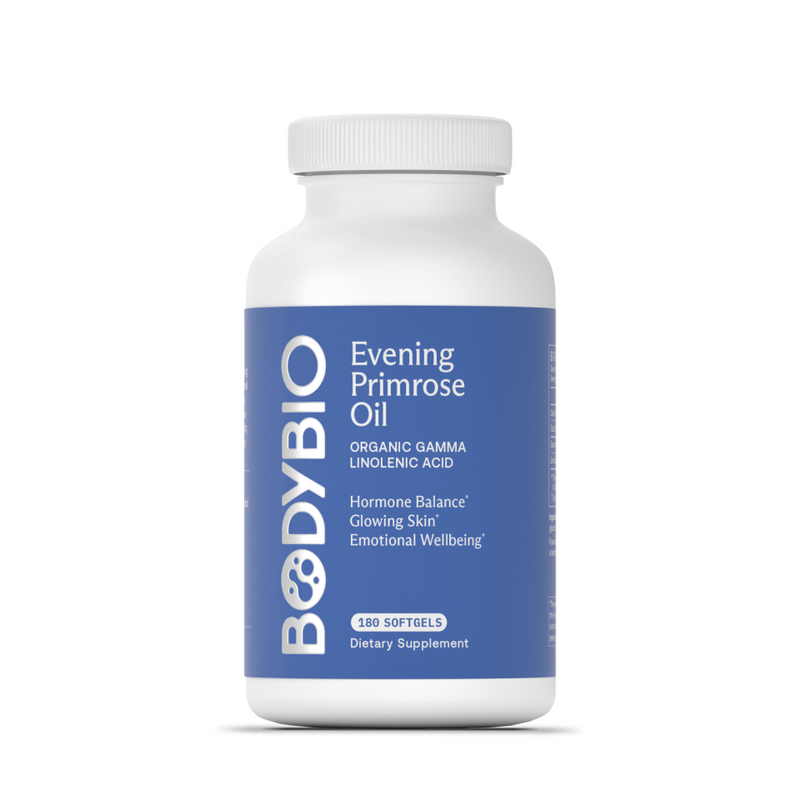
Day to day, evening primrose oil's main job is supplying the fatty acids your membranes use. BodyBio Evening Primrose Oil is cold-pressed and hexane-free, with 250 mg of GLA and 1,743 mg of linoleic acid in every two-softgel serving to support women's health, hormonal balance, skin health, and mood.*
Supporting Your Cells Through Perimenopause With Evening Primrose Oil
Perimenopause is unpredictable, but it isn't a mystery. Your symptoms feel scattered because the hormonal signal has become irregular, and your body is adjusting to a new rhythm.
The goal was never to force your hormones into one perfect number. It's to understand what's happening, get real care for the symptoms that affect your life, and give your cells steady raw materials along the way.
That's the role evening primrose oil is made for. Every serving supplies GLA and linoleic acid your cell membranes can use, alongside the Balance Oil and PC that round out your lipid foundation.* Your membranes are constantly renewing themselves from the fats you give them, so consistency matters more than any single dose.
So the confusing symptoms you’ve been experiencing? You're not imagining it. And you have more options than you might think.
Support your cells through every season of change. Explore BodyBio Evening Primrose Oil.*
If you are pregnant, nursing, or taking medication, consult your healthcare practitioner before using this product.