


EPO and Skin Health: What GLA Means for Your Skin Barrier
Authors:

Ashley Palmer
Nutritional Therapy Practitioner, Health & Wellness Expert
Key Takeaways:
Your skin feels dry no matter how much moisturizer you use. Some mornings it's tight and flaky along your cheeks or the folds of your elbows. Other times it just looks dull, like it can't hold onto anything you put on it. If you deal with eczema or atopic dermatitis, this cycle probably feels familiar: something helps for a while, and then it stops.
Evening primrose oil comes up often in this search because of a compound called gamma linolenic acid (GLA), a fatty acid your body relies on but doesn't always produce enough of on its own. GLA plays a specific role in how skin holds moisture and maintains its structure, and that role starts well below the surface, in the membranes of your skin cells.
In this article, we'll look at what GLA actually does in the body, how it connects to your skin's barrier, and what the research says about EPO and eczema.
Table of Contents:
-
What Is Evening Primrose Oil?
-
GLA: The Fatty Acid Your Body Struggles to Make
-
How GLA Supports the Skin Barrier
-
The Cellular Health Connection
-
Does EPO Help With Atopic Dermatitis and Eczema?
-
Getting the Most From EPO
What Is Evening Primrose Oil?
Evening primrose oil is cold-pressed from the seeds of the Evening Primrose, a wildflower long used for its fatty acid content. Most of the oil is linoleic acid, an essential fatty acid found in many plant oils, while gamma-linolenic acid (GLA) makes up about 8 to 10 percent.
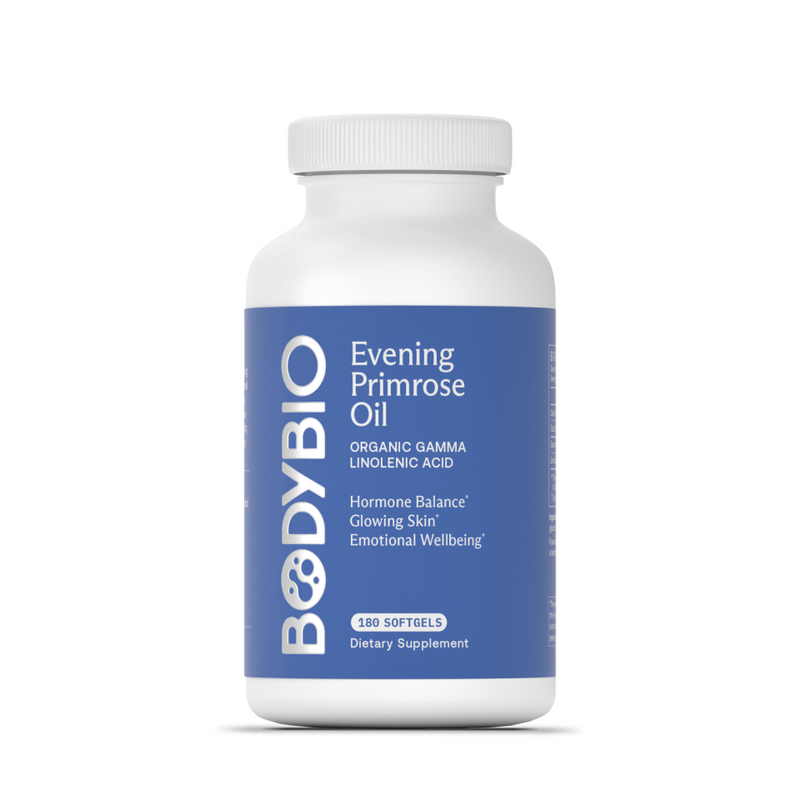
Most diets provide plenty of linoleic acid. GLA is the rare part. Outside of evening primrose, borage, and black currant seed oil, it's hard to get it directly in your diet. BodyBio EPO softgels deliver both in a concentrated, cold-pressed form, with a two-softgel serving providing 250 mg of GLA and 1,743 mg of linoleic acid.*
GLA: The Fatty Acid Your Body Struggles to Make
Here's the part most explanations skip: your body can make GLA from linoleic acid, but the conversion depends on an enzyme called delta-6-desaturase. That process is relatively slow and can be limited by factors including aging, alcohol intake, insulin resistance, and low zinc or B6 status.
When that conversion slows, the body has less GLA to use, even if you're getting plenty of linoleic acid from food.
Your skin can't make GLA on its own, either. It relies on GLA delivered through the bloodstream. Getting GLA directly from Evening Primrose Oil bypasses that conversion step rather than relying on the body to make it first.
How GLA Supports the Skin Barrier
Once absorbed, GLA converts into a compound called DGLA, which the body uses to build signaling molecules that support a healthy inflammatory response.*
This is one reason GLA shows up repeatedly in omega-6 fatty acid research. Not as a blanket anti-inflammatory compound, but as a specific input into how the body regulates its own inflammatory signaling.
Apart from GLA, linoleic acid does equally important work at the barrier itself, which is part of the broader case for fatty acids for skin health. It gets built directly into specialized ceramides in the outermost layer of skin—the structural lipids that hold skin cells together and keep water from escaping.
Some research has found that people with atopic dermatitis tend to have lower levels of these linoleic acid–derived compounds in their skin, alongside higher water loss through the barrier. This is a useful clue about why barrier-supporting fats matter.
The Cellular Health Connection
Every cell in the body, including skin cells, is wrapped in a membrane built largely from fatty acids sourced through the diet.
That membrane isn't fixed. Its composition shifts gradually as new fatty acids are incorporated, a process that plays out over weeks rather than days. It's part of why membranes rebuild themselves slowly, using the raw materials that are consistently available. Skin, as the body's outermost and most visible barrier, makes that process most observable to us.
But that process isn't limited to skin.
Every cell you have depends on membranes—the outer membrane, plus the folded inner membranes of your mitochondria, where energy is produced.
Hormone receptors sit embedded in those layers, and their function depends partly on the fats surrounding them. Nutrients move in, and waste moves out across these same structures.
The quality of those fats matters, too. Oxidized or heavily processed fats can stiffen membrane structure, while intact essential fatty acids provide the raw materials cells use to maintain healthy membranes and cellular communication.
Your skin barrier is the visible edge of a process happening in every cell, organ, and tissue.
Does EPO Help With Atopic Dermatitis and Eczema?
The research on EPO is still ongoing. Small studies do point to its role in skin barrier support. A 12-week placebo-controlled study in healthy adults found that daily EPO measurably improved skin moisture, elasticity, and firmness while reducing water loss and roughness.
Those changes weren't measurable at four weeks, only after sustained use. That timeline matters. It matches how membrane fatty acid composition changes gradually over time.
Most importantly, no significant adverse effects have been reported, making EPO a safe option to try if you're looking to support your skin health.
Getting the Most From EPO
Consistency is important. Here's what the timeline actually looks like:
The First Four Weeks: Too Soon to Judge
In the 12-week study that found measurable skin barrier improvements, researchers saw no significant difference between the EPO and placebo groups at four weeks. That doesn't mean nothing was happening. Changes in skin and membrane composition take time.
Between Weeks 4 and 12: Where Patience Matters
Skin is constantly renewing itself, and normal epidermal turnover takes several weeks. Fatty acids are also gradually incorporated into cell membranes, not changed out overnight.
By Week 12: The Differences Were Measurable
Participants taking EPO showed improvements in skin moisture, elasticity, firmness, roughness, and water loss compared with placebo.
The study doesn't say exactly when, between weeks 4 and 12, those changes began. It does show that the benefits measured at 12 weeks weren't there yet at week four.
BodyBio recommends taking two softgels with food. That serving provides 250 mg GLA and 1,743 mg linoleic acid to support skin hydration, elasticity, and a healthy inflammatory response.*
EPO is generally well tolerated. Because GLA may affect platelet function, talk to your healthcare practitioner before use if you take anticoagulant or antiplatelet medications, are preparing for surgery, or are pregnant or nursing.
Your Skin Barrier Starts With Your Cells
Dry, reactive skin often gets treated as a surface problem, solved with the next skincare product on the shelf.
The barrier itself tells a different story. Your body builds it from lipids, assembling them from the fatty acids you take in, one slow membrane cycle at a time. GLA is a specific, well-understood piece of that supply chain. Not a cure for eczema, but a real input into how your skin holds structure and moisture over time.
Give the fatty acids time to do their slow, structural work, and the skin barrier follows.
Support your skin barrier with BodyBio Evening Primrose Oil.*